Art Review: Anila Quayyum Agha’s “Geometry of Light”
“Geometry of Light,” an exhibition from Pakistani-American artist Anila Quayyum Agha, lights the walls of the Seattle Asian Art Museum with the floral motifs, geometric mandalas, and architectural ornamentation of ancient Islam. Like the architecture of the Middle East, Agha’s designs are constructed from material and immaterial elements. She projects light through latticed screens cut with arabesque designs, saturating their surroundings with magnified patterns of light and shade. These multidimensional works allow Agha to revisit her past and also invite close examination of the forms and customs of her native culture.
Agha’s sculptural pieces extend beyond the limits of their form. Her designs, as she said in a previous artist statement, “inhabit a large space, covering and beautifying all within it, and suggesting the underlying orderliness of the cosmos revealed through the purity and symmetry of geometric design.” But her return to the designs of her native culture also reveals the contradictory nature of Islam’s customs. Agha’s works, as she told Designboom, “explore the deeply entwined yet contradictory political relationships between gender, culture, religion, labor, and social codes.”
“Liminal Space”
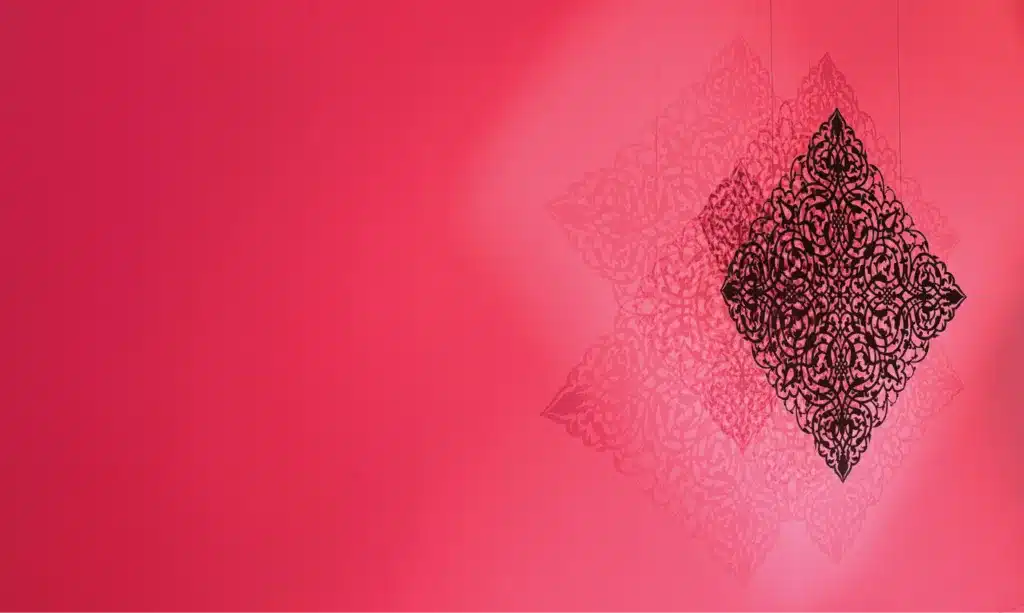
Agha’s “Liminal Space” (2021) brings these contradictions into focus by blurring them. The piece is a black square screen that hangs, tilted like a diamond, against a bubblegum-pink wall. The metal screen is laser-cut into a mandala of symmetrical floral designs. Leafy flower stems loop and spiral out from the center, sprouting leaves along the way and budding at the edges. The screen hangs at eye level, slightly out from the wall. Lights illuminate the mandala from each side, converge at its center, and cast four shadows outward in four directions, overlapping the square diamonds to form a deep pink, eight-pointed star of intertwining spirals behind the sculpture.
For Agha, light has been a means to revisit her past. When she emigrated from Lahore, Pakistan, to the U.S., she said her memories of home distilled into one gleaming visual recollection. “In my mind’s eye,” she told Designboom, “beloved faces of family and friends became closely entwined with Lahore and its […] bright sunlight filtering through the canopy of trees.” Agha continues to revisit her past through light, now with her art. She added that her sculptures are informed by the light of Islamic architecture, specifically the jaali screens of Southeast Asia. These carved stone window screens, featuring geometric and floral patterns, “enabled fresh air to filter through the ancient buildings to alleviate the oppressive heat and brightness of the region,” she explained. The carved openings also allow sunlight to filter through the buildings and “cast mobile shadows” that shift throughout the day with the sun.
Agha’s designs function similarly. Her layered and multidimensional works, she told Artnet, “[depend] both on the space in which [they are] installed, the arrangement of the installation, and the various paths that individuals take while experiencing the space.” Moving around the screen, its shadows rearrange behind it. Overlapping spirals of steel and shadow shift in and out of alignment. Leafy black outlines fill with scrolling pink gradients in a flutter of burgundy that appears to shake the leaves as if a breeze is blowing through, blurring the rigid edges. The borders of the screen appear to dissolve into the backdrop.
“A Beautiful Despair”
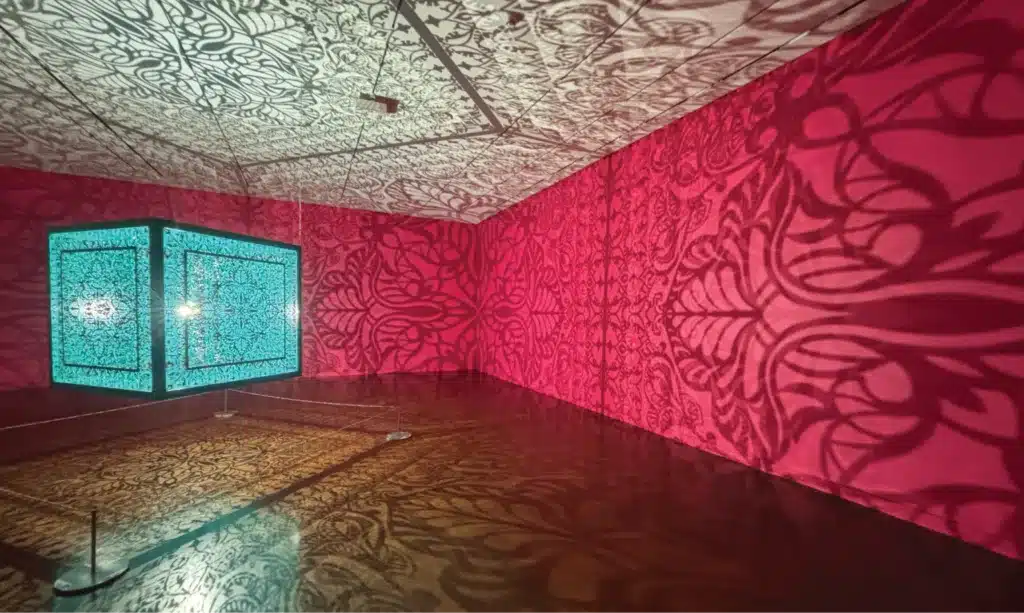
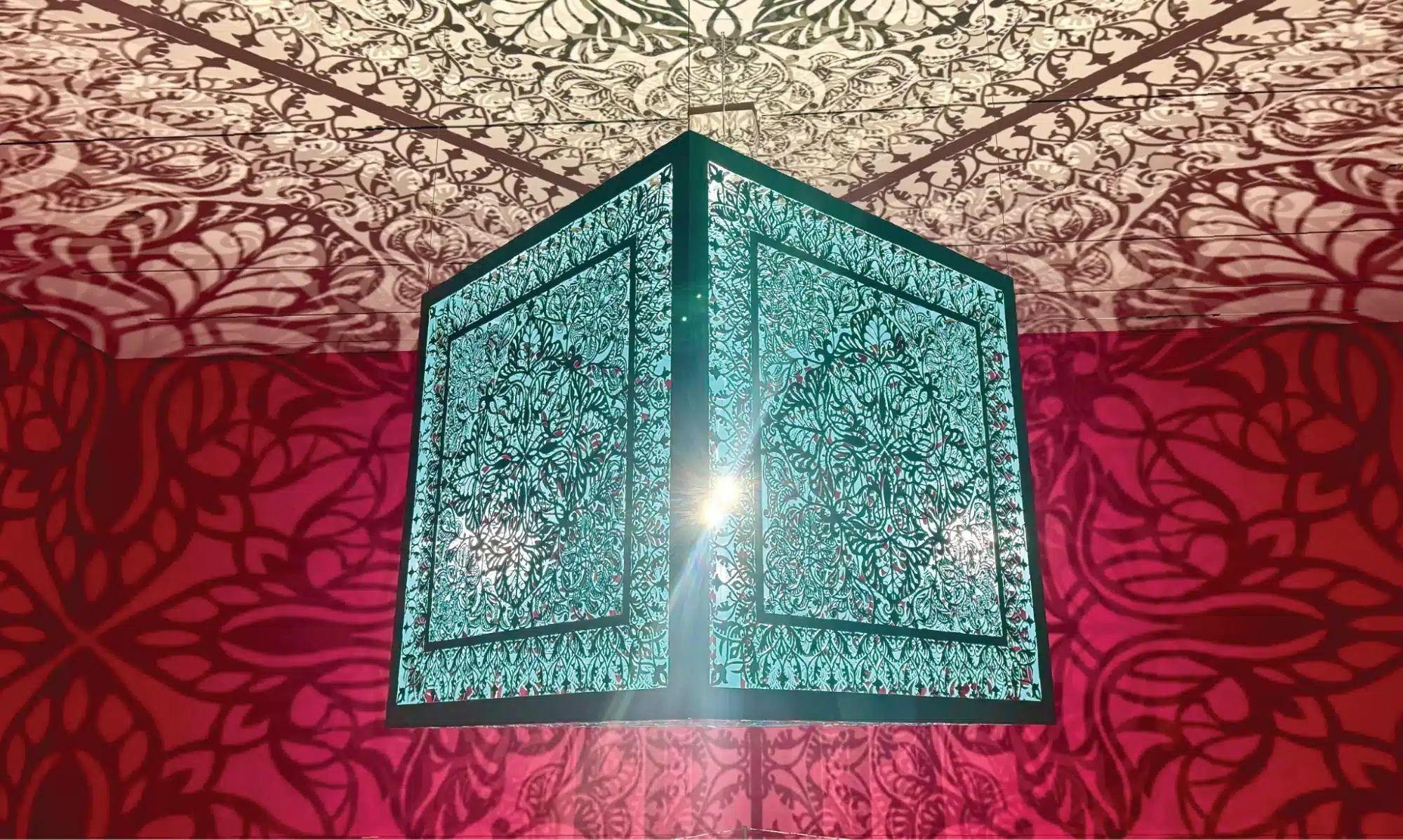
The exhibit’s focal point, “A Beautiful Despair” (2012), is a large metal cube that hangs as if floating at the center of the room. The cube glows blue through six sides of black metal screens, casting patterns of burgundy shadows across the blush colored walls. “The cube represents the Kaaba,” Agha said in an interview with Asian Art. The Kaaba, Islam’s most sacred site, is a cube draped in a black shroud. Agha’s cube is laser-cut with floral designs. “In my practice, I am blowing it open,” she added, “putting a very feminine pattern on it derived from architecture.”
The cube gleams with repeating motifs of winding stems, interlacing branches, and blooming petals that radiate out from a mandala of mirrored leaves unfolding at the center. Looking through the cube, identical leaf patterns on adjacent sides align and overlap. Moving toward it, leaf veins merge and separate as if shuttering open and closed, flickering with light. From the teal-blue interior, light filters through the black metal foliage. It casts its shadows in all directions, amplifying a visual echo of botanical motifs throughout the room, which is otherwise silent except for the soft hum of the small light fixture.
The cube is positioned like a diamond within the square room, with each side pointed toward a corner, angling light and shadow across the walls so that shadows stretch, lines extend, and shapes expand, growing in distorted symmetry. The shadow of one big teardrop leaf balloons sideways as if floating out of the room.
Agha said she uses geometric symmetry and shadows to explore tensions between light and dark, as well as public and private space. “I grew up in an environment where public space was never mine,” she told Asian Art. In Pakistan, she said, women and girls are often excluded from mosques. Growing up, Agha’s religious and cultural practices were regulated in the home. But, as an adult, when the artist exhibited her first cube sculpture, she said the audience “felt they were coming into a mosque, a religious environment […].”
“A Beautiful Despair” has the same effect. Stems vault up walls, branches arch across the ceiling, and oversized leaves tower over the room like Islamic architecture. The ceiling appears to crown and bulge skyward like a dome. Vines reach like buttresses, flower bulbs stand like minarets, and yet beneath the shadows lies only flat drywall of minimal design.
“The viewer is invited to confront the contradictory nature of all intersections,” Agha told Artnet, “while simultaneously exploring boundaries.” Viewers circle the cube, half-camouflaged in its patterned glare, glowing like the moon, with one side of their bodies lit and rippled with wavy lines, the other side shaded and dark. They eclipse the already broken light, projecting their figures against the wall to merge with the shadowed foliage, moving through lines, filling gaps of light with shade, and reshaping the form of the piece.
Textiles

Shifting her focus from the public to the private, and from the sacred to the domestic, Agha scales down her work with a series of intricate textile collages. These works combine layers of paper drawings and stained plastics. The floral designs feature geometric motifs in various shades of white and are ornamented with colorful embroidery.
“Flowers (Red)” (2018) is a circular paper collage, resembling a placemat, mounted flat in a shallow shadow box. Stacked round cutouts stagger out from the middle, bordering its white core with red, lace-like floral rings so thin the edges curl away from the glass and into the recess of the frame.
“I have used combinations of textile and sculptural methodologies to reveal and question the gendering of textile/craft work as inherently domesticated and excluded from being considered a fine art form,” Agha explained to Designboom.
With “Warhead II” (2023), Agha crafts art with raised beadwork and metallic stitching. The piece is an off-white paper disc patterned with faded circular motifs. At its center, tiny red beads silhouette the petal folds of a blooming floral figure. A scalloped semicircle of marbled polygons, embroidered with metallic thread, halos above the red bloom like the crowning sun of an eclipse.
Agha, as she does with her light installations, revisits her past through these textile works. “The sewing,” Agha continued, “referenced memories of sewing circles my mother organized annually with women in our neighborhood.” She said the women would sit in Agha’s backyard in a circle, with one quilt at a time stretched between them, and restitch the year’s wear, while underneath the canopied fabric, young Agha would play and eavesdrop on the conversations above. “I’d listen to the women talk about their lives,” she recalled, “touching upon husbands, children, education or lack thereof, limited opportunities with menial jobs, and […] domestic violence.”
“Dream Catcher II” (2023) is a marbled plastic crest stained with arabesque leaf designs. At its center, copper thread is stitched into a cross. Lines of copper beads stretch from the center to the cusped edges. The leaves are fastened with a constellation of silver beads that speckle a silver mandala across the plastic, presenting like a jeweled shield.
“This is NOT a Refuge!”
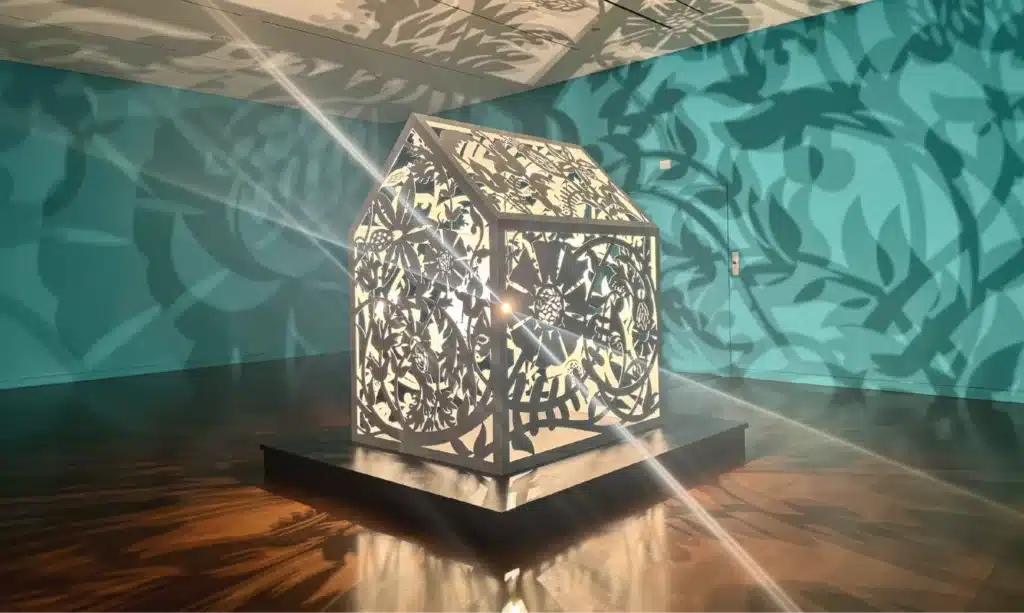
Agha continues to spotlight domesticity with her installation “This is NOT a Refuge! 2” (2019). The piece is a house-shaped structure, about five feet tall, lacquered glossy white and laser-cut with a lush arrangement of floral figures that cast shadows across the blue room from floor to ceiling. Its four walls and pitched roof beam light through a variety of floral cuts resembling lilacs, jasmine, and daisies in a swirl of curling vines. A large sunflower projects into a corner, fanning out across the diverging sky-blue walls a burst of shade in the shape of a beaming sun.
A small light fixture with two bulbs, one positioned slightly higher than the other, hangs from the structure’s roof. The dual, lopsided light doubles the shadows. Every projection is followed by its faint double. The foliage thickens, multiplying seeds on flower heads, unfolding flower petals in tiers, and threading vines into a tall weave of leafy swirls across the walls and around the room.
Long shadows reach from the house to the wall, stretching across the brown floor like roots. Flower stems, projected the size of tree trunks, cast up the walls, branch across the ceiling, and, like the trees of Lahore, canopy the space in a leafy flourish of light and shade.
“All my past experiences coalesced,” Agha told Designboom, “allowing me to explore and combine pattern, light, and shadow as materials in my art practice.”

Cody Clemons
Cody is a student at Seattle Central. After several years in Portland, OR, he has recently returned to Seattle. Now, as a contributor to The Collegian, he focuses on reporting stories affecting Capitol Hill and Seattle Central, and provides commentary on larger cultural and political issues.