
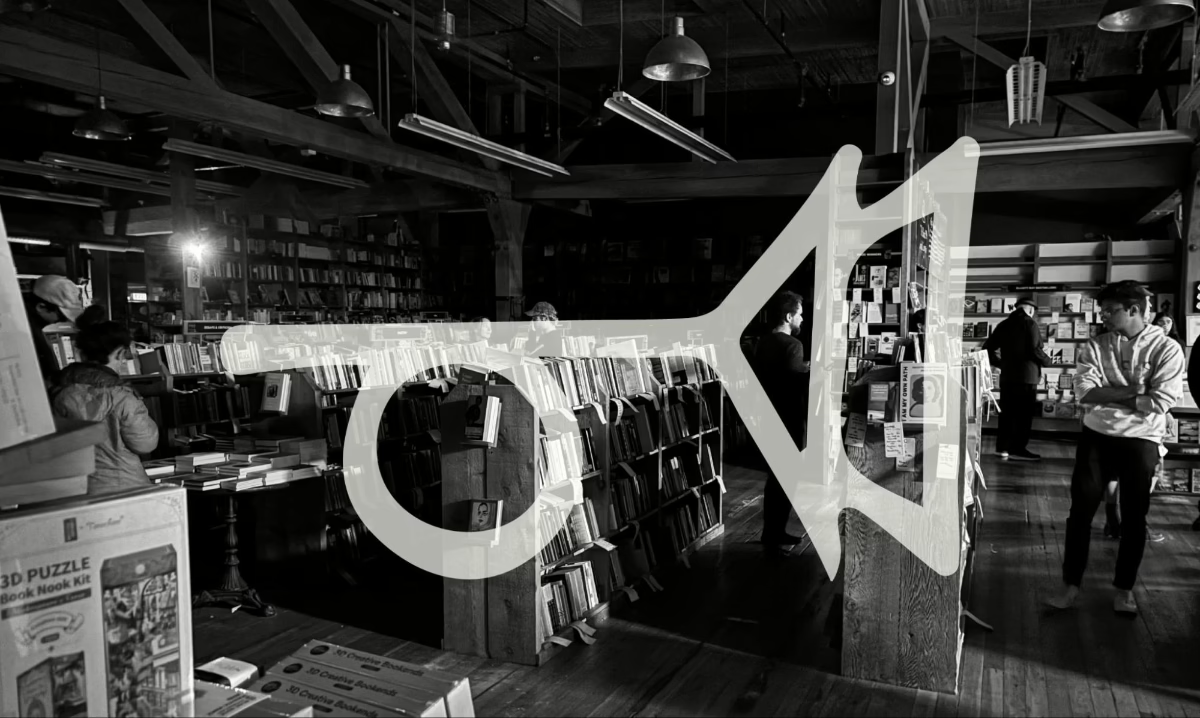
Pynchon’s projections: Elliott Bay Book Company’s midnight book release
On the night of Oct. 6, a small group of dedicated readers waited outside Elliott Bay Book Company’s locked doors for their copies of Thomas Pynchon’s latest book, “Shadow Ticket.”
The midnight release for Pynchon’s “Shadow Ticket” gave his fans a night similar to one of his books: a quest through obscure communities in search of a hidden text concealed by some unseen force. At Elliott Bay Book Company, fans got two Pynchon stories for the price of one.
Under the cloak of darkness
Outside Elliott Bay Book Company, an hour after closing, almost a dozen quiet strangers stood patient, ready, staring up the steps at the bookstore’s entrance, dark and empty inside. Two employees wearing dresses burst out of the front doors. Ticket holders formed a short line and moved up the steps through a QR code scan and into the bookstore for the event.
In the days leading up to the event, customers entering the bookstore could find a flyer that read:
“Rumours bound of some kind of clandestine celebration of the latest novel from Thomas Pynchon… to happen under the cover of darkness on 6 October… and, at the stroke of midnight, your own copy of the new hardcover book ‘Shadow Ticket,’ out from Penguin Press.”
Under the text, watermarked at the bottom of the flyer, was the faint outline of a trumpet-shaped horn—a symbol from Pynchon’s 1966 book “The Crying of Lot 49,” which fans have adopted as the emblem of their fandom.
This is not Harry Potter
In the past, midnight book releases were mostly reserved for genre fiction, particularly fantasy. Midnight releases gained traction in the late 1990s with J.K. Rowling’s “Harry Potter” series.
Rowling’s publishers, Bloomsbury and Scholastic, perfected their already successful midnight release model in 2000, when they publicized new embargoes on “Harry Potter and the Goblet of Fire.” These embargoes barred early copies for critics and threatened legal action against distributors and retailers who leaked the book. The mystery surrounding the book led to even more media coverage and publicity.
Pynchon, at 88, still writes with the imagination of a child, but “Shadow Ticket” is no children’s book. It is his first novel in 12 years. The story follows private investigator Hicks McTaggart and swing clarinetist Hop Wingdale in the search for Wingdale’s missing fiancée, cheese heiress Daphne Airmont. Their search takes them from Prohibition and Depression-era Milwaukee to the rise of fascism in Budapest. Along the way, they encounter a cocaine-addicted Interpol agent, a Nazi biker gang, bombers disguised as elves, and a telekinetic.
Before “Shadow Ticket,” Elliott Bay Book Company’s most recent midnight release in November 2024 was for Haruki Murakami’s “The City and Its Uncertain Walls.”
Recently, publishers have been promoting more literary novels with midnight releases. This strategy allows for promotional events that don’t require the author’s presence—especially for those prominent enough to skip publicity tours.
The invisible man
Pynchon rose to literary prominence with the publication of his debut novel, “V.” in 1963, and won the National Book Award for his seminal work “Gravity’s Rainbow” in 1974.
Last month, the film “One Battle After Another,” adapted from Pynchon’s 1990 novel “Vineland,” topped the box office. Now, nearing his ninth decade, “Shadow Ticket” is expected to be one of Pynchon’s final releases.
Pynchon is a famous recluse. In his six-decade career, he has never given an interview. Until recent years, only about five grainy black-and-white photos of a young Pynchon were known to exist.
When he won the 1974 National Book Award for “Gravity’s Rainbow,” Pynchon didn’t show up to accept it. Instead, he sent an impersonator, an absurdist comedian named Professor Irwin Corey.
In 1997, his former publisher, Henry Holt & Co., promoted his novel “Mason & Dixon” with a look-alike contest at a bar in Manhattan, where Pynchon was rumored to have lived at the time. Attendees said that during the event, a suspicious man wearing sunglasses and a big hat entered the bar, sat in the back, and rushed out once people noticed him. Whether this man was Pynchon, a look-alike, or a marketing ploy, the sighting became another myth among fans.
Projections
The muted post horn—a line with a loop in the middle and two staggered triangles flaring out at the end—was introduced in “The Crying of Lot 49.”
It tells the story of Oedipa Maas, a bored California housewife, who searches for a copy of a suppressed version of an obscene Elizabethan play. On her quest, she moves through a network of underground communities who communicate via the mysterious W.A.S.T.E. system, a secret alternative postal service beyond the reach of the U.S. government, symbolized by the muted post horn.
As the story moves along, Oedipa increasingly spots the post horn everywhere—engraved on an elderly man’s ring, watermarked on a collectible stamp, pinned to a man’s lapel—all leading her to conspiratorial thoughts and paranoia. At one point, Oedipa copies the symbol into her notebook from a bathroom wall and writes beneath it: “Shall I project a world?”
Pynchon fans answered this question as if it were a challenge. Since the book’s release, they have perpetuated the horn symbol globally—on jewelry, apparel, stickers, and tattoos. Fans have even collaborated on a public Google Map called “W.A.S.T.E.,” which catalogs locations of stickers and graffiti of the symbol. It lists two on Capitol Hill and twenty total in Seattle.
With his reader’s help, Pynchon has projected a world—his own world.
Milwaukee’s Best
Attendees filed in and found themselves in the dimly lit bookstore with swing music playing softly in the background and black-and-white film reels of ocean liners projected onto the wall. The store was empty except for a few well-dressed employees, a small table of drinks and appetizers, and, on the front counter, displayed atop an arrangement of his past releases, Pynchon’s new book, “Shadow Ticket.”
One attendee entered and asked an employee, “Will the author be here?”
“Sometimes he’s late to arrive and sometimes he doesn’t show.”
The same attendee then spotted an elderly man wearing a fedora and sweatpants shuffling past him and asked, “Mr. Pynchon?”
“Uh, everybody is Mr. Pynchon!” the man replied.
The ticket line extended across the checkout lanes and ended at a table where attendees were treated to an assortment of Wisconsin cheeses, crackers, and the choice of a cherry cider mocktail, a Wisconsin Old Fashioned garnished with a pickled Brussels sprout, or a simple glass of milk.
The event ran out of cocktails within 10 minutes. The store began to fill with fans, ranging from young to old. About half the attendees came alone. Near the front, strangers mingled, discussing jazz, the plays of Bertolt Brecht, the philosophies of Umberto Eco, and the Vietnam War, while others, as if it were still normal business hours, expanded into the unlit reaches of the bookstore, perusing the aisles and dotting the fiction, history, music, and film sections by the light of their phone flashlights.
Up front, fans chatted around the table where only a few cheese cubes remained, along with some empty bottles and an unopened gallon of milk.
Two stories for the price of one
Pynchon remains America’s foremost postmodern author. Literary critic Kevin McHale calls Pynchon’s novels “heteroglossic.” McHale argues that instead of writing from a single character’s perspective, Pynchon writes from the perspectives of dozens throughout one novel. Another Pynchon scholar, Brian McHale, argues that these multiple perspectives combine to form a “collective enterprise wherein none of us could succeed without the help of the others.” Pynchon’s narration seeks to embrace every perspective. In a sense, Mr. Pynchon is everybody.
Because of his postmodern style, critics for years have scrutinized Pynchon for his use of ‘flat’ and ‘unrelatable’ characters. The same critiques have already been made of “Shadow Ticket.” But anyone following a muted post horn through a cult-like community in search of a concealed text hidden by some shadowy figure is living out a Pynchon novel in real life.
Powers that be
The hostess called everyone up front for trivia. For the easier questions, almost all attendees raised their hands before the question finished; for the harder ones, a few die-hard fans showed off their encyclopedic knowledge of Pynchon.
Those who answered correctly received “Shadow Ticket” merchandise, black hats, tote bags, and T-shirts, supplied by Penguin Press.
With 30 minutes to midnight, the first few words of “Shadow Ticket” were revealed. Printed on the merch with the novel’s cover art: “When trouble comes to town…”
Penguin Press approached Elliott Bay, along with several other bookstores around the country, and asked if they’d like to hold a midnight release for “Shadow Ticket.” A few Pynchon fans on Elliott Bay’s staff pushed for it.
Penguin Press coordinated with Elliott Bay, sending them a playlist and trivia questions. Sofia Brekken, the evening’s hostess and Elliott Bay’s events coordinator, said publishers are trying this new approach to promote authors who don’t tour.
“Pynchon wasn’t going to make his way to Seattle,” Brekken said.
In Pynchon’s books, powerful corporations often turn out to be the true force behind communities and gatherings of outsiders, bohemians, and freaks. Elliott Bay’s gathering of Pynchon devotees was no different.
Lifting the embargo
At seven minutes to midnight, a man in a suit jumped onto the front counter and called for attention, drawing fans out of the dark book stacks and into the lobby for the main event.
He opened “Shadow Ticket,” and the room fell silent. He read the first two pages of the novel like a carnival barker reciting a tongue twister. When he finished, he slammed the book shut and announced to the crowd, “My latest novel—” he began, then corrected himself, “the latest novel—is now available.”
The clock struck midnight, and attendees formed a line at the counter. One by one, each fan collected their hardcover copy.
The bookstore emptied out slowly. Some fans stayed longer to chat, and a few stood outside the entrance flipping through the new novel. After 12 years of silence, Pynchon was back with his fans.
In his earlier books, Pynchon’s characters never truly finish their search. Forces of oppression impede them, leaving them with only unanswered questions. In his later books, particularly “Vineland” and “Bleeding Edge,” Pynchon delivers a more hopeful tone. These books suggest that systems of control can only be challenged with community and collective action.
Like his characters, Pynchon’s readers have built their own community of outsiders. His fans have become his characters.

Cody Clemons
Cody is a student at Seattle Central. After several years in Portland, OR, he has recently returned to Seattle. Now, as a contributor to The Collegian, he focuses on reporting stories affecting Capitol Hill and Seattle Central, and provides commentary on larger cultural and political issues.