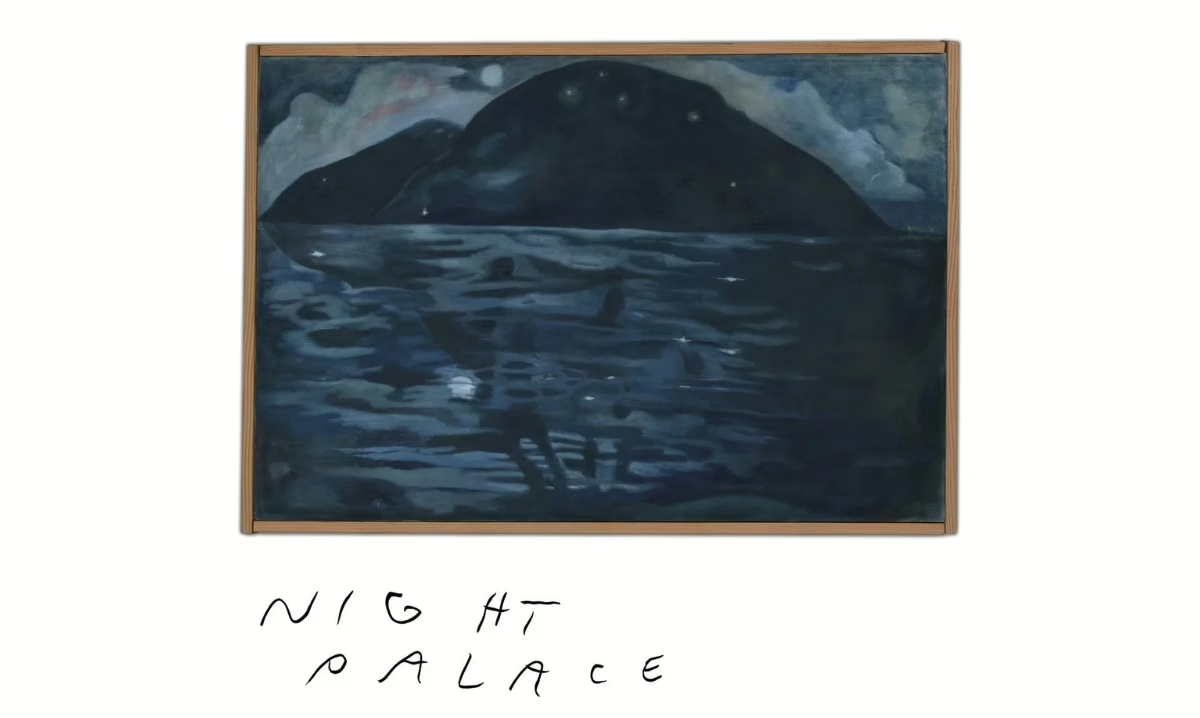

Change the Record: J. Cole – “The Fall-Off”
People like strong opinions. It’s really cool in this day and age if you either love something or hate it; people don’t value neutral opinions on things. It is because of this that I hesitate when talking about J. Cole, who I have completely neutral opinions on—straight middle of the road. So middle of the road, in fact, that I’m practically one with the median strip. Come with me as I try to unpack these average feelings into something with any value.
For those unfamiliar, J. Cole is a rapper from North Carolina who has been in the rap industry since 2007, which, despite how time feels, means he has been active for about 19 years. He’s made a name for himself in the industry as one of the more respected rappers in modern mainstream hip-hop. He made waves in the early 2010s with albums like “Born Sinner” and “2014 Forest Hills Drive,” which were mostly enjoyable, if occasionally dated or forgettable in my opinion. For the general public, however, they were massive hits, and with subsequent records, he was rocketed harder and harder into becoming one of the faces of mainstream hip-hop. He was even considered one of the “Big Three” alongside Drake and Kendrick Lamar. Kendrick later rendered that meaningless after turning Drake into flambé, but that is a separate discussion.
That brings us to today and the album before us: “The Fall-Off,” an album Cole has been teasing for about eight years now, ever since he revealed the album’s existence on his 2018 record “KOD.” I have already discussed how hype can bite an artist in the rump with A$AP Rocky, but Cole at least had the courtesy to release more music in the meantime, with the solid “The Off-Season” in 2021 and the absolutely embarrassing “Might Delete Later” in 2024. In the 2020s, Cole faced growing criticism, probably not helped along by having a frankly humiliating 2024, where he dissed Kendrick and then, two days later, apologized for the track and removed the song. A move that might have once seemed respectful just made him look embarrassing in this case.
He rebuilt his reputation in 2026 with the release of a solid EP of hardcore hip-hop tracks, culminating in “The Fall-Off,” a massive, artist-defining double album. Unfortunately, “artist-defining” can also run the risk of defining the artist as deeply flawed.
This is a large album: 24 songs and nearly two hours long. I’m going to break from the typical formula and talk about the album more generally rather than go track by track. Cole works in three main styles of hip-hop: he makes high-energy tracks, lyrical tracks, and smoother singing tracks, so I’ll discuss each style separately.
The album is ostensibly a double album, with the first disc telling the story of his return to his hometown, Fayetteville, at 29, and the second disc telling the story of his return at 39, but the album does not fully commit to this concept. Some tracks stick to this, like the third song, “SAFETY,” where he talks about the friends he has lost. This includes part of the final verse, where he reflects on his past homophobia in a way that’s similarly clumsy to Kendrick’s “Auntie Diaries.” It very much comes off as a cishet man’s earnest but kind of ignorant view of a homophobic past, albeit he at least has the grace not to say any slurs.
The album also includes “What If,” where Cole raps from the perspective of Tupac and Biggie in an alternate universe where they made up with each other. It is a premise I was skeptical of; it has a lot of potential to be extremely corny if done wrong. Ultimately, however, Cole plays it pretty safe, with a general attitude of “Damn, that’d be crazy” and a broad message of unity.
The album is not all bad; plenty of tracks like “Bunce Road Blues” and the closer, “and the whole world is the Ville,” offer solid reflections on Cole’s mindset. Additionally, on the track “I Love Her Again”—while not a new premise for a rap song (rapping about falling in love with hip-hop as if it were a woman)—Cole brings enough energy and passion to make it convincing. My favorite lyrical track here by far, though, is “Lonely at the Top.” It is not groundbreaking, but Cole puts his heart into the writing, and his insecurities and anxieties come through clearly throughout the track.
A style I think he does much worse than his lyrical work, though, is melodic music. I won’t mince words: J. Cole sucks at melodic tracks. He doesn’t have the vocal ability to carry the melodies, nor the emotional intensity to sell the emotions of the tracks, meaning he leaves these songs mostly flat. The album as a whole has issues with its production, a lot of it feeling generic and forgettable, so Cole being a mediocre singer only leaves these songs more out of place. “Bombs in the Ville/Hit the Gas” is a prime example; the production is awkward, with these thin, plucky strings layered awkwardly over a set of generic drums. It makes Cole’s singing sound low-effort, almost amateurish to an extent, which you wouldn’t expect from someone of his caliber.
To round this out, we have the bangers: the harder-hitting tracks without the singing, the stories, or anything especially notable. If the lyrical tracks are the highlights and melodic tracks are the low points, then these land in the middle. The second track, “Two Six,” is a decent bop, but without much drive or hunger, it feels like a weak way to start the album. Then there are the tracks “WHO TF IZ U” and “Old Dog,” which have nearly identical intros. However, “WHO TF IZ U” wisely switches beats to a better, more interesting song, while “Old Dog” gets stuck with the generic, piano-based beat from the intro that feels straight out of a GarageBand preset. The only banger I fully love is “39 Intro,” the opener to the second half of the album. Despite some shaky singing, it changes course halfway through to a full guitar solo, then a sample-based, soulful track where Cole raps harder than anywhere else on the album. It’s the only track where I felt like I really got what made Cole interesting in the broader hip-hop landscape.
Honestly, this review ended up being longer than I expected; guess I had a lot to say. So, where does all of this leave us? Well, it leaves us with a mixed bag. I don’t know how to feel about Cole’s original claim that this would be his last album. On one hand, I’m happy he’s gonna keep going after this, and hopefully keep improving, but on the other hand, I think this album is a clear reflection of Cole as an artist. Undeniably interesting and eye-catching, but ultimately unable to keep my attention for long. He’s the musical equivalent to a dandelion.

Hello there stranger, this is Kate Megathlin, writer for weekly music reviews for the Seattle Collegian, here to assert how much more important her opinions are than yours. She is a Seattle Central student with a major love of music and music culture, and every week she’ll try to deliver reviews of new albums coming out, if you want to recommend albums for her to review, email her at Kate.Megathlin@seattlecollegian.com.