Marking one year since the start of President Donald Trump’s second term, Seattle demonstrators joined a nationwide strike Tuesday, Jan. 20, answering a call to be “ungovernable” in the face of what organizers called an “escalating fascist threat.”
At 2 p.m., protesters gathered on the plaza at Seattle Central College for the “Free America Walkout.” The event, coordinated nationally by Women’s March and coalition partners, was framed as “a protest and a promise,” a “rupture” — a calculated withdrawal of labor and commerce meant to disrupt what organizers described as the “normal routines of power.”
“A free America begins the moment we refuse to cooperate,” the campaign’s manifesto read, a message echoed in speeches and signage throughout Capitol Hill. The walkout targeted a specific set of administration policies, including intensified U.S. Immigration and Customs Enforcement (ICE) raids, the deployment of National Guard troops in U.S. cities, and legislative actions affecting transgender rights.
The Seattle contingent, many wearing red, white, and blue as requested by national organizers, marched from Broadway to Pier 58. The killing of Renee Good — a 37-year-old Minneapolis woman fatally shot by an ICE agent Jan. 7 — became a galvanizing force for the movement, sharpening a long-standing demand to abolish the agency into a specific, urgent call for accountability.
As the crowd moved toward the waterfront, they rallied under the campaign’s unifying slogan, “Everybody in, nobody out,” a pledge to protect marginalized communities from the “terror used to keep us silent.” They also carried the core declaration of the Free America movement — a rejection of the Trump administration’s rhetoric and a reclaiming of patriotism: “We walk out because a Free America is the only America worth calling great.”
All quoted materials within this article are sourced from the Free America website.
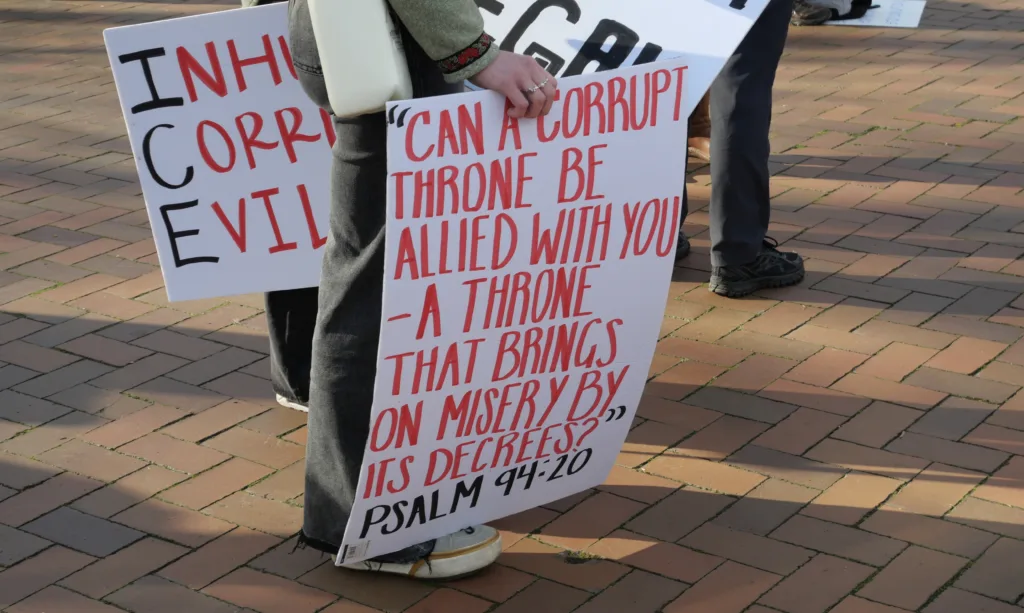
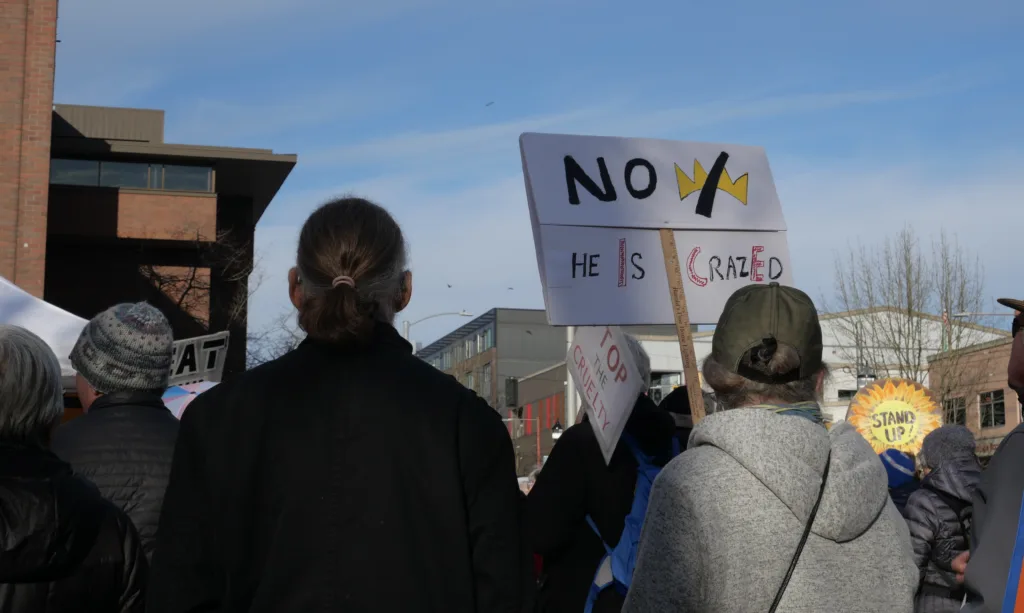
Danika Djuanda | The Seattle Collegian Demonstrators fill the rainbow crosswalks of Capitol Hill, carrying signs reading “Stop ICE” and “Stop Trump.”Danika Djuanda | The Seattle Collegian A marcher carries a placard calling on the government to “Deport Trump back Home to Hell.”Danika Djuanda | The Seattle Collegian Against the brick facade of Seattle Central College, protesters hold a sign comparing ICE to the “Un-American Gestapo,” using a cross-shaped arrangement of the words.Danika Djuanda | The Seattle Collegian A protester rests on a concrete ledge, holding a bright orange sign that requests “Democracy with NO ICE.”Danika Djuanda | The Seattle Collegian A marcher holds a handwritten excerpt of Emma Lazarus’ “The New Colossus,” including the lines “Give me your tired, your poor,” evoking the poem inscribed on the Statue of Liberty.Danika Djuanda | The Seattle Collegian A sign presenting a stark choice — “Respect Existence or Expect Resistance” — stands out against the brick buildings along Broadway.Danika Djuanda | The Seattle Collegian A demonstrator lists personal reasons for marching, listing “my 90-year-old mother,” “Renee Good,” and “my trans neighbors.”Danika Djuanda | The Seattle Collegian A bold black placard reading “Crush ICE for Good” stands out in the crowd; the slogan references both the demand to abolish the agency and the name of Renee Good, a woman fatally shot by an ICE agent in Minneapolis.Danika Djuanda | The Seattle Collegian A marcher holds a pink sign featuring a Cornel West quote, “The rule of law is the public face of love,” alongside a demand for “Justice for Renee Good!”Danika Djuanda | The Seattle Collegian A demonstrator sits on the curb beside a sign that warns onlookers and officials: “History Will Remember What You Do Today.”Danika Djuanda | The Seattle Collegian A participant holds a handwritten sign calling on the crowd to “Care for Each Other,” reflecting the mutual aid networks that have become central to the “Free America” organizing strategy.Danika Djuanda | The Seattle Collegian A sign reading “We Are Not Safe! If they can kill her, they can kill anyone!” rises above the crowd, linking the recent death of Renee Good to broader fears of state violence.Danika Djuanda | The Seattle Collegian A placard challenges the government rhetoric on political dissent, asking: “The gov. says anti-fascists are terrorists… what does that make you?”Danika Djuanda | The Seattle Collegian Members of the Seattle Raging Grannies pose with a sign reading “Say Her Name: Renee Nicole Good.”Danika Djuanda | The Seattle Collegian A marcher lists essential democratic tenets — “Freedom of Speech,” “Voting Rights,” “Due Process,” and “Freedom from Fear” — on a sign held among the crowd.Danika Djuanda | The Seattle Collegian Demonstrators display signs reading “No Kings” and “Impeach the Trump,” directly challenging the legitimacy of President Trump’s second term.Danika Djuanda | The Seattle Collegian A protester holds a sign criticizing ICE as “Inhumane, Corrupt, Evil” while carrying a jug of milk, a common aid used by activists to treat the effects of chemical irritants.Danika Djuanda | The Seattle Collegian A demonstrator holds a cardboard sign reading “ICE is Trump’s Gestapo,” listing words such as “Lawless,” “Immoral,” and “Violent.”Danika Djuanda | The Seattle Collegian A marcher holds a sign quoting Psalm 94:20 — “Can a corrupt throne be allied with you” — using scripture to critique the morality of the administration.Danika Djuanda | The Seattle Collegian A protester holds a sign featuring a stylized crown with a strikethrough reading “He Is Crazed,” criticizing the consolidation of executive power.Danika Djuanda | The Seattle Collegian A golden retriever wears a patriotic bandana — adhering to the “red, white, and blue” theme of the walkout — while wearing a sign asking for “justice” and “treats.”
Danika is an aspiring journalist based in Seattle. Born and raised in Jakarta, she has long been drawn to the gravity of stories—the way they hold what might otherwise slip through the day. As editor-in-chief, she approaches her work with curiosity more than certainty, trusting small details to reveal larger truths. For her, storytelling is less about control than attention: a practice of listening closely and noticing what remains after the noise.
The popularity of house shows in the University District has increased over these past few years. More venues are opening up, shedding a spotlight on many of the local bands in the Greater Seattle area. One of these venues attracting both college students and punks alike is called Evil House. Evil House was founded in…
After reviewing so many popular, mainstream musicians, I think it’s high time I finally get another indie record on the chopping block. My indie band of choice for this occasion is Windmill scene’s finest, Squid. The band hails all the way from Brighton England, a seaside town outside of London known for their music scene….
Friends and community members blocked the intersection of Broadway and Pine to call for justice in the recent road rage incident that took Elijah Lewis’ life and injured his 9 year old nephew.
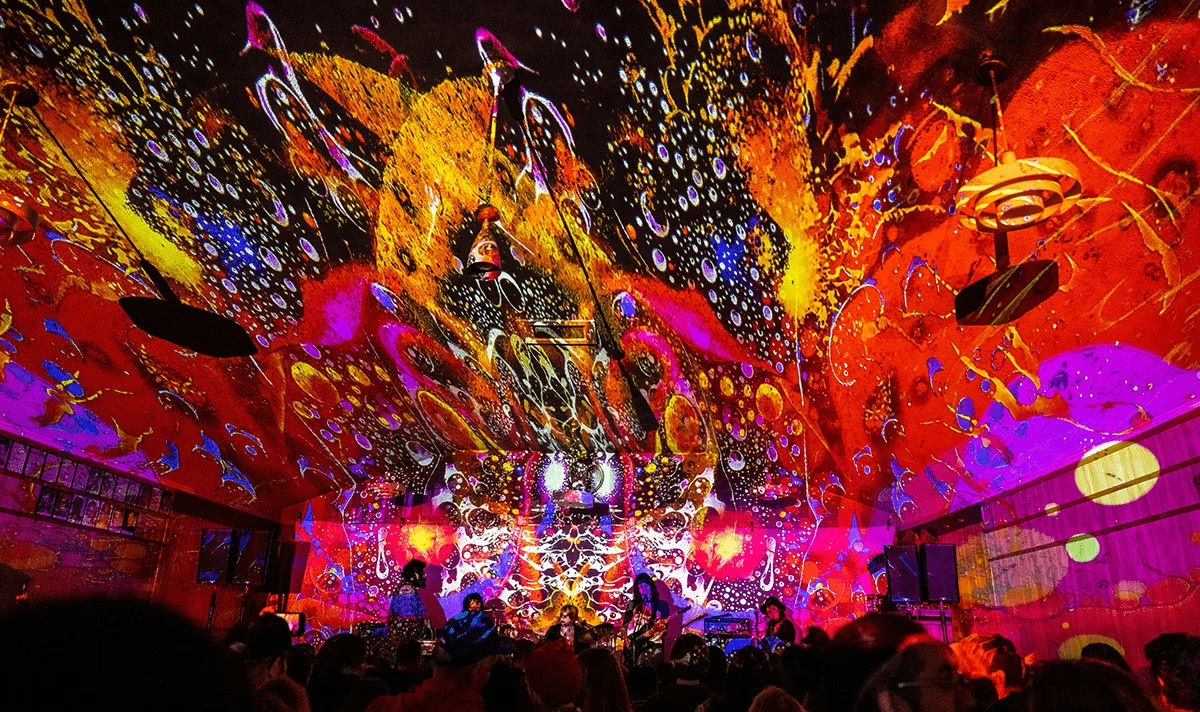
In the dead of winter 2013, a group of friends set up an epic party dubbed the Psychedelic Holiday Freakout. It was successful enough to make a yearly tradition. In the decade since, the Freakout Festival (as it was rebranded in 2017) has grown, but one aspect remains constant — it’s still an epic party,…
On March 6, hundreds of Seattle residents amassed to protest the ongoing atrocities committed against women in Tigray, Ethiopia. The rally called for the end of rape and assault of Tigray’s mothers and daughters, who have become casualties in the ongoing war fought between the Tigray People’s Liberation Front (TPLF) and the Ethiopian National Defense…
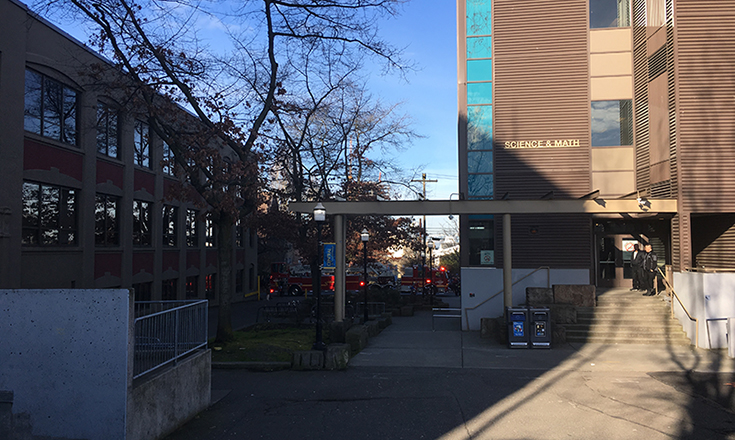
At 9:15 on the morning of March 15, the fire alarm in Seattle Central’s Science and Math building (SAM) went off. All students and staff in the building evacuated and waited for nearly 30 minutes as the fire department arrived, cleared the building, and left. According to the Security Office at Central, no evidence of…